Brain-Chipped Bird Drones: Start of Living Surveillance Machines
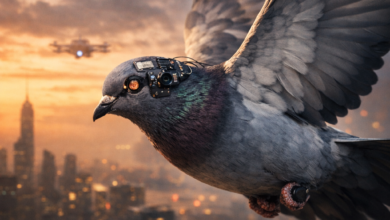
In recent years, drone technology has advanced from quadcopters to stealth surveillance crafts, but nothing has created more global debate than Russia’s Brain-chipped bird drones. Instead of building metal UAVs, scientists now implant neural electrodes into real pigeons, attach tiny sensor packs, and guide them using brain-signal stimulation — turning biology into robotics. These AI-guided aerial birds need no engines or propellers, blend naturally with urban flocks, and operate with unmatched stealth. A normal-looking pigeon circling skyscrapers could actually be observing a target through Remote neural surveillance. Russia claims these Brain-chipped bird drones require no behavioral training — neural implants activate specific brain regions, and the bird changes direction like a remote aircraft. This fusion of neurons instead of motors, instinct instead of code, introduces a new espionage class known as Military biological spying tech, where life itself becomes the drone.
Brain-chipped bird drones: The Origin of the Neural Bird Project
While rumors and speculation dominate online discussions, several verified reports indicate that a Russian neuro-technology division began experimenting with organic drones nearly six years ago. Early prototypes involved wired brain-interfaces, short-distance flight tests, and manual lab stimulation. Now, however, wireless systems reportedly enable long-range monitoring and semi-autonomous pathing. The shift from laboratory to open-air trials suggests a new technological readiness stage.
The goal, according to published statements, is to develop a scalable Brain-chipped bird drones — a biological surveillance network capable of monitoring hostile terrains, border entries, powerlines, industrial regions, and city infrastructure. At its most ambitious, it could provide real-time video from bird-eye level without the risk of losing expensive drone hardware. A pigeon can glide for hours without battery drain. It requires neither charging pads nor remote fueling bases. Nature itself powers it.
Ethically, the concept ignites deep concern. Using living animals as surveillance devices introduces moral dilemmas that humanity has never confronted on this scale. Yet researchers behind the Pigeon-based drone program argue this innovation could benefit society far beyond espionage. Disaster sites where drones cannot navigate — collapsed tunnels, wildfire zones, narrow forest paths — might be safely surveyed by AI-guided aerial birds. Lost-person rescue missions could become faster. Environmental research could reach new territories without expensive aircraft.
Even the scientists developing Brain-chipped bird drones admit this technology holds double-edge potential — remarkable progress and dangerous misuse.
Brain-chipped bird drones: How Remote Neural Control Works
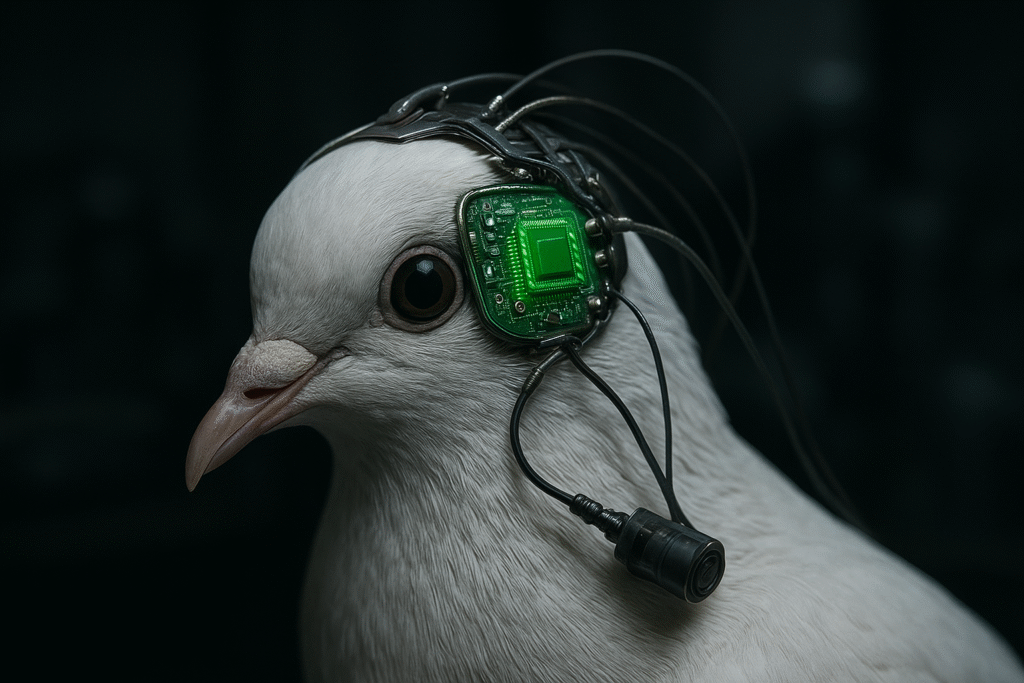
At the core of this project is Remote neural surveillance, a system based on neuro-stimulation and receiver-transmitter communication. Electrodes implanted in the Brain-chipped bird drones send micro-impulses that trigger directional decisions. Left-flight neurons are stimulated to turn west. Right-flight pathways guide movement east. Higher intensity impulses elevate altitude. Lower stimulation brings descent. Birds do not consciously resist — their brain pathways interpret commands like instinctive urges.
Now imagine fifty AI-guided aerial birds deployed across a metropolitan area. Each one could record wide-angle visuals, detect radio frequencies, identify heat patterns, or relay movement through micro-transmitters. They could map city layouts undetected, bypass radars, slip through windows, and return to base like regular pigeons landing at a rooftop nest.
This transforms warfare, policing, and intelligence forever. It also transforms privacy.
If the Military biological spying tech ever becomes accessible to non-state actors, the world must prepare for unpredictable consequences. A criminal organization could spy without satellite access. Private corporations could monitor employees secretly. Authoritarian governments could track dissidents with flocks of harmless-appearing pigeons. Civil freedom discussions would have to include not only CCTV cameras, facial recognition, and digital tracking — but also flying organic spies above every neighborhood.
Global Shock and Debate
Tech analysts, governments, human rights groups, animal welfare federations, and defense ministries have all begun to respond to this development. Some call it scientific genius. Others call it biological militarization. Many simply do not know what future awaits.
A number of Western agencies fear that Brain-chipped bird drones may soon travel beyond Russian airspace. Their silent infiltration ability would bypass border radars easily. Unlike metal drones, birds do not reflect radar strongly. Unlike spy satellites, they fly unpredictably and invisibly across urban skylines, blending into normal city life. A hundred pigeons perched on telecommunication towers could just be wildlife — or a monitoring network.
Several environmental researchers believe AI-guided aerial birds could revolutionize ecological knowledge. With onboard sensors, they could track pollution, methane leaks, wildfire expansion, deforestation patterns, agricultural nutrient decline, or melting ice layers. This is where scientific communities find hope — using Remote neural surveillance for planetary protection rather than global surveillance.
But critics warn that hope must not overshadow threat. In history, every dual-use breakthrough has entered weaponization. Neuro-enhanced pigeons birthed energy — and bombs. Artificial intelligence birthed innovation — and cyberwar tools. Now Military biological spying tech births possibility — and danger.
Psychological Impact — A New Fear in the Sky
Humans find comfort believing surveillance has a physical form: a drone buzzing audibly, a satellite visible in orbit, a camera mounted at street corners. But Brain-chipped bird drones remove visibility. They weaponize the ordinary. A creature sitting on your balcony could be filming. A bird crossing your window at night could be mapping. The familiar suddenly becomes foreign.
This subtle psychological disruption is powerful. Surveillance becomes invisible. Awareness becomes paranoia. Cities become open targets. A state no longer requires fleets of aircraft or supercomputers — only a flock of pigeons.
This existential shift demands ethical policy. International regulation must define how Neuro-enhanced pigeons technologies are developed, tested, and deployed. Without global agreements, one nation’s innovation becomes another nation’s threat.

The Future — Expansion or Restriction?
Future scenarios divide into two possible paths:
Scenario 1: Global Adoption
More countries replicate Military biological spying tech, forming competitive bio-drone programs. Organic surveillance becomes a new class of warfare. Cities equip anti-avian monitoring units. Skies become silent battlegrounds.
Scenario 2: Ethical Regulation
International councils enforce protocols:
• Limited deployment
• Mandatory transparency
• Animal ethics review boards
• Anti-abuse legal penalties
• Peace-time usage restrictions
This allows AI-guided aerial birds only for rescue, research, and environment protection — not espionage. Innovation survives, but humanity remains protected.
Which scenario unfolds depends on policy, cooperation, and awareness. Technology itself will not choose. People must.
Final Reflection — Are We Crossing a Line?
The world stands at a border where intelligence meets instinct, and machinery merges with biology. The invention of Brain-chipped bird drones is not merely technological progress — it is evolution’s redirection. For the first time, humans can guide the living flight of another species using electricity and code. The question is no longer “Can we do this?” It is now “Should we?”
What happens when remote control extends to other animals — ravens, eagles, wolves, dolphins? What happens when surveillance hides inside life itself? As awe-inspiring as Remote neural surveillance may sound, responsibility must guide innovation. Progress without caution becomes domination.
If used ethically, this breakthrough may save forests, reduce disaster casualties, rescue missing hikers, detect nuclear leaks, protect animals, and reduce global environmental loss. But if misused, Military biological spying tech could become the most powerful silent weapon ever created — one that flies unnoticed across borders and through the lives of millions.