How Starlink Works: Beginner-Friendly Guide for Tech Lovers
If you’re a tech lover, you’ve probably heard about Starlink — the satellite internet service by SpaceX that promises lightning-fast, global internet access. But if you’ve ever wondered How Starlink works explained in a simple, non-technical way, this guide is exactly what you need. This is a truly beginner friendly tech tutorial, designed to simplify something that usually sounds complex. As someone who writes about gadgets and futuristic innovations regularly, I’ve always been fascinated by the idea of getting internet “from space.” So today, you’ll finally understand the system behind it — a clear, practical Starlink satellite internet guide made for every curious reader who wants to know how satellites, covering low orbit satellites, and antennas create the internet connection on your laptop or smartphone.
How Starlink works explained: What Is Starlink in the First Place?
Starlink is a space based broadband system created by SpaceX. Unlike traditional internet that depends on underground fiber cables or cellular towers, Starlink uses thousands of satellites orbiting close to the Earth to deliver high-speed internet to homes, vehicles, and soon — smartphones.
Here’s the purpose in simple words:
Bring fast internet to remote and rural areas
Reduce latency for video calls and gaming
Offer a stable connection during disasters or outages
Provide global internet coverage without needing towers
Because it’s built entirely on satellites, understanding Starlink starts with understanding low orbit satellites, which we’ll explain shortly.
Starlink’s Secret Weapon: Low Earth Orbit Satellites
Traditional satellites are placed extremely far away from Earth — around 35,000 km high. That distance causes slow speeds and high latency.
Starlink uses a different strategy. It places satellites in Low Earth Orbit (LEO) — only about 550 km away. This tiny difference changes everything.
How Starlink Works: Why LEO is important:
- Faster data transfer
- Lower latency (20–40 ms)
- Better performance for gaming and video calls
- Stronger coverage because satellites move quickly
This is the foundation of covering low orbit satellites, and it makes Starlink one of the most advanced internet systems ever built.
The Complete Process: How Starlink Actually Works
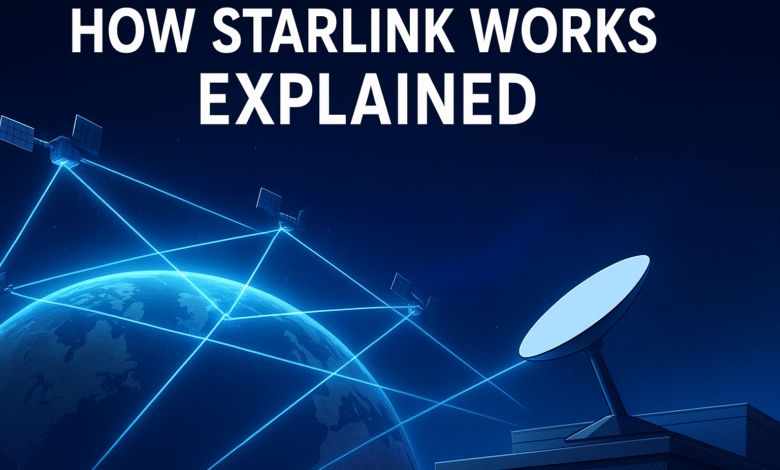
Let’s break down How Starlink works explained in the simplest way possible. Think of it like a three-step communication chain:
Ground stations send data to satellites
On Earth, Starlink has powerful ground stations. These stations are connected to the global internet backbone.
They send internet signals upward to the satellites using high-frequency radio waves.
How Starlink Works: Satellites talk to each other using lasers
This is where Starlink becomes futuristic.
Starlink satellites communicate with neighboring satellites through laser interlinks.
This creates a giant internet mesh in space.
Think of this as a cosmic version of fiber optics — except the “fiber” is beams of light traveling through space.
This step is essential in any Starlink satellite internet guide, because it explains why Starlink works even when there is no ground tower nearby.
Satellites send data down to your Starlink dish
Your home dish — often called “Dishy” — receives the signal from the nearest satellite and transmits it to your router.
So finally:
Satellite → Dish → Router → Your Devices
This entire process happens in milliseconds.
A truly futuristic beginner friendly tech tutorial, right?
How Starlink works explained: Why the Starlink Dish Is So Smart
What most people don’t know is that the Starlink dish is not like a regular TV dish. It has advanced technology built inside:
Self-orienting
The dish automatically rotates to track the closest satellite.
How Starlink Works: No technician required
Plug it in, link the app, and it sets itself up.
Weather-resistant
Rain? Snow? Dust? It still works.
Honestly, the dish is a key part of the space based broadband system, because it ensures stable connection even when satellites are constantly moving across the sky.
Starlink vs Traditional Internet: Big Differences
It’s easy to understand Starlink if you compare it with what we use today.
Traditional internet uses cables — Starlink uses space
Fiber internet requires miles and miles of underground cables.
Starlink needs none of that because it relies on satellites.
Starlink is available almost anywhere
Remote villages, mountains, forests, deserts, oceans — you name it.
This is one reason people search for Starlink satellite internet guide again and again.
Much lower latency than old satellite internet
Old satellite internet could take 600 ms or more.
Starlink usually stays around 20–40 ms.
How Starlink Works: Laser communication makes it extremely fast
The laser-linked satellites transfer data almost at the speed of light.
This is possible because of the advantage of covering low orbit satellites and how they enable Starlink’s unique speed and reliability.
A Deeper Look: How Starlink Works Explained (In Detail)
Let’s walk through the full system step by step — crisp, clear, and easy.
- You click on a website.
- Your request travels from your device → router → Starlink dish.
- The dish beams the signal to a satellite overhead.
- That satellite transfers your request to another satellite through lasers.
- The satellite with the best route sends your request to the nearest ground station.
- The ground station connects to the global internet.
- The response from the website moves back through the satellites → dish → your device.
Every single step takes milliseconds.
This is the heart of How Starlink works explained, and it’s why space internet can compete with fiber internet today.
How Starlink works explained: Who Actually Needs Starlink?
Starlink is not just for tech lovers. It solves real-world problems.
Rural homeowners
No fiber, DSL, No problem.
Travelers
RV owners, vanlifers, truck drivers.
Remote workers
Writers, developers, and online businesses.
Emergency services
Hospitals, rescue teams, disaster relief units.
Airlines & Ships
Soon, global WiFi with low latency.
And soon, thanks to innovations like the upcoming Apple Starlink iPhone feature, the concept of a space based broadband system will reach millions of smartphone users without needing a dish.
The Future of Starlink: What’s Coming Next?
Starlink is growing fast, and the next few years look revolutionary.
Expected developments:
- Direct-to-smartphone satellite internet
- Starlink-enabled drones and robotics
- 6G-style satellite connectivity
- Self-healing global laser networks
- Starlink on electric cars and autonomous vehicles
- Smaller, more powerful dishes
- Expanded coverage for Africa, Asia, and remote islands
This is why readers love a Starlink satellite internet guide—the technology is evolving so fast that it feels like sci-fi turning real.
Why Learning This Matters
Understanding this system makes you realize how advanced modern communication has become. It also prepares you for upcoming changes in mobile networks.
If you grasp covering low orbit satellites, you can easily understand:
- Satellite phones
- Space-based cybersecurity
- Satellite-powered IoT
- Future global 6G networks
- Next-generation emergency communication
The world is moving toward a space-powered future — and Starlink is only the beginning.
Conclusion: The Internet Has Officially Reached Space
Starlink is more than just a new internet service.
It is a complete reinvention of how the internet works.
In one sentence:
Starlink uses a low-orbit satellite network to deliver fast, reliable, global internet directly from space.
Now you finally have How Starlink works explained in a clear, engaging, beginner-friendly way — all through a beginner friendly tech tutorial built for modern tech lovers.
As satellites get smarter, dishes get smaller, and lasers get faster, one thing is clear:
The future of the internet is above us — literally.