Bio-Hybrid Drones: When Birds Become Surveillance Tools
Bio-Hybrid Drones: A Bird That Watched Too Much
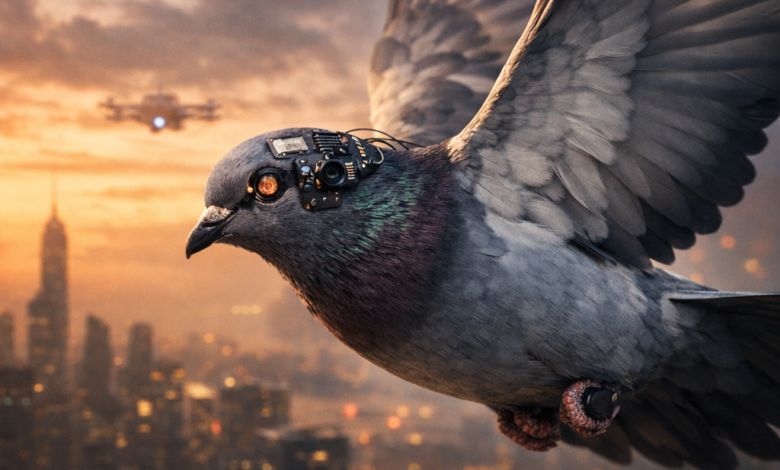
The bird appeared harmless, perched quietly above the street, yet it was part of Bio-Hybrid Drones, a system built for living surveillance. Through advanced bird drone technology, its natural instincts were guided by hidden neural implants, turning the creature into one of many unwilling animal cyborgs. It watched without understanding why — recording faces, movements, and moments meant to stay private. This was silent spying at its most disturbing, because nothing about the bird looked artificial or threatening. As days passed, the constant signals altered its behavior. It paused mid-air, lingered unnaturally, and followed paths it never chose itself. The sky was no longer freedom; it was a monitored route. In that moment, the bird became a symbol of how technology can quietly cross moral boundaries, proving that when surveillance learns to breathe and fly, it stops feeling like innovation and starts feeling like loss.
Bio-Hybrid Drones: What Exactly Are Bio-Hybrid Drones?
Bio-Hybrid Drones are not machines pretending to be alive.
They are living beings enhanced with technology.
Unlike traditional drones built from metal and code, Bio-Hybrid Drones rely on:
- Real animals (mostly birds)
- Embedded neural implants
- Micro surveillance sensors
- Wireless communication chips
“Instead of building machines that imitate life, we began rewriting life itself.”
These systems blend biology and engineering so seamlessly that detection becomes nearly impossible. A bird flying over a military zone does not raise suspicion — that’s why living surveillance is so powerful.
Why Birds Became the Perfect Surveillance Platform
Birds already possess what engineers struggle to replicate:
- Perfect aerodynamics
- Silent movement
- Natural camouflage
- Long endurance without batteries
Through bird drone technology, militaries realized birds could outperform traditional drones in sensitive areas.
“The most advanced drone is the one nature perfected millions of years ago.”
From pigeons to crows, birds became silent data collectors — the face of modern silent spying.
Bio-Hybrid Drones: The Science Behind Neural Implants
At the heart of Bio-Hybrid Drones lie neural implants — microscopic electrodes placed into specific brain regions.
These implants do not fully control the bird like a robot. Instead, they:
- Stimulate navigation instincts
- Guide direction subtly
- Trigger flight or landing responses
“We don’t command the bird. We influence decisions it believes are its own.”
This makes the bird an unwilling participant in living surveillance, raising serious ethical questions.
From Animals to Cyborgs
When technology merges with biology, a new category emerges: animal cyborgs.
These creatures remain alive, yet their autonomy is compromised. They eat, sleep, and migrate — but parts of their nervous system answer to external signals.
“Once a living creature becomes a platform, morality becomes optional.”
Bio-Hybrid Drones blur the line between tool and life, pushing science into uncomfortable territory.
Silent Spying: Surveillance Without Sound
Silent skies no longer mean privacy. In the age of Bio-Hybrid Drones, silent spying has evolved into a form of living surveillance that leaves no mechanical trace. Through advanced bird drone technology, ordinary birds blend effortlessly into their surroundings while hidden neural implants guide their movement and data collection. These airborne observers do not buzz, flash, or warn — they simply exist, watching patiently. Unlike traditional machines, these animal cyborgs raise no suspicion as they perch on windowsills or glide above restricted spaces. This silence is what makes the surveillance so powerful and unsettling. People are conditioned to ignore birds, trusting them as part of nature. Yet behind that trust, information flows quietly, moment by moment. When surveillance loses its sound, detection becomes nearly impossible, and the boundary between natural life and technological intrusion quietly disappears.
Bio-Hybrid Drones: A Border Incident Nobody Could Explain
Leaked intelligence reports describe a strange event near a restricted border.
No drones were detected.
No surveillance equipment found.
Yet detailed footage of patrol routines surfaced days later.
“The footage moved like it was breathing. That’s when we realized — it wasn’t a drone.”
This was bird drone technology at work.
Ethical Dilemma: Is This Still Science?
Bio-Hybrid Drones raise questions that technology alone cannot answer.
- Can animals consent?
- Is minimal invasion still exploitation?
- Where do we draw the line?
Animal rights activists argue that animal cyborgs represent a dangerous normalization of control over life.
“When we weaponize nature, we lose our humanity.”
Supporters counter that living surveillance reduces human casualties and increases national security.
Psychological Impact of Living Surveillance
Knowing drones exist is one thing.
Knowing birds might be watching you is something else entirely.
The fear of silent spying creates:
- Constant paranoia
- Loss of trust in nature
- Psychological stress
“The sky was once freedom. Now it feels like a ceiling of eyes.”
Future Applications: Where Does It Stop?
The future of Bio-Hybrid Drones stretches far beyond birds, opening the door to a world shaped by living surveillance. As bird drone technology continues to evolve, scientists are already imagining other species enhanced through neural implants. Marine animals could quietly monitor underwater cables, borders, or submarines, while land-based creatures might track movement across difficult terrain. These developments push animal cyborgs from experimental projects into everyday security tools, normalizing silent spying as part of modern defense systems.
What makes this future unsettling is how easily it could become invisible. Once society accepts surveillance woven into nature, resistance fades. Silent spying would no longer feel intrusive because it would look alive and familiar. In such a world, living surveillance stops being a choice and becomes an environment, raising the frightening question of whether any space — land, sea, or sky — can ever remain truly private.
What Happens When Control Fails?
When control fails, the consequences extend far beyond a single experiment. A bird altered through neural implants may lose its natural instincts, flying without direction or abandoning migration patterns that ecosystems depend on. Such failures can disrupt food chains, confuse breeding cycles, and create long-term ecological imbalance. Even more troubling is the ethical cost — a living being trapped between instinct and command, unable to return fully to nature. In the context of Bio-Hybrid Drones, a technical glitch is not just a system error; it becomes a moral failure, exposing the fragile line between innovation and irreversible harm.
Normalization Is the Real Threat
The greatest danger of Bio-Hybrid Drones is not misuse.
It’s acceptance.
Once society shrugs at living surveillance, resistance disappears.
“The scariest future is the one we stop questioning.”
Final Thoughts: Watching the Watchers
Bio-Hybrid Drones represent a future where:
- Nature becomes infrastructure
- Life becomes hardware
- Surveillance becomes invisible
As birds continue to fly freely above us, one question remains:
Are they free… or are they part of the system?
“When surveillance grows wings, hiding becomes impossible.”